

Division Clinton is building an ESD (Enhanced Services District) that strengthens our neighborhood for businesses, residents, and visitors alike.
What is an ESD?
Enhanced Services District: How We Make Things Happen
An Enhanced Services District (ESD) is a business community-powered funding tool, one that lets local business and property owners pool resources to invest in improvements we decide on together. It's not a tax. It's our money, going directly back into our district.
For Division Clinton, an ESD could fund things like:
Marketing and Events that support foot traffic, coordinated resources and streamlined engagement with city resources.
Prioritized programs and services that strengthen the independent, locally-owned businesses that define the Division Clinton corridor's unique character.
Additional resources to maintain a streetscape environment that is clean, well-lit, accessible, and inviting for all who live, work, and visit the corridor..
Infrastructure support for garbage cans, lighting, storefront support and more.
And here's what makes this different: we run it. The business community sets the priorities, approves the budget, and holds the work accountable.
ESDs deliver incredible results with more foot traffic, cleaner sidewalks, robust storefronts, and more dollars staying local.
An ESD is…
A business community-led funding model
A way to leverage the City for support and engagement
A way to pool resources and drive positive outcomes for business and the neighborhood
A structure that ensures consistent, reliable funding and services
An ESD is not…
A City program telling you want to do (we run the work)
A bureaucracy with no accountability (all reports are public)
A replacement for business decisions (we make all decisions)
A tax (this is a fee structure that is fully reinvested in the district)
What does accountability look like?
ESDs are independent nonprofit organizations with robust nonprofit, governance, and public accountability related to their setup, budget, service delivery, and board engagement. Please explore a number of accountability measures that will be implemented into a Division Clinton ESD.
-
An ESD is an independent 501c3 nonprofit, following all of the rules and regulations of a standard nonprofit delivery services to the community.
-
ESDs are required to regularly hold ratepayer Board of Director meetings
-
ESDs are required to provide program and service tracking measures to the ESD Coordinator (at least quarterly) and those reports are posted on the City’s ESD webpage for anyone to view.
-
ESDs are required to produce an independent financial audit at least every three years
-
ESDs are required to produce and share an Annual Report to City Council and their ratepayers each year.
-
The City of Portland ESD Coordinator is an ex-officio, non-voting member of the ratepayer Board of Directors, and the City of Portland City Council approves ESDs.
-
ESDs are required to host at least one meeting open to all ratepayers annually.
-
ESD budgets are included in reporting and City of Portland contracting process.
Proposed ESD Boundary
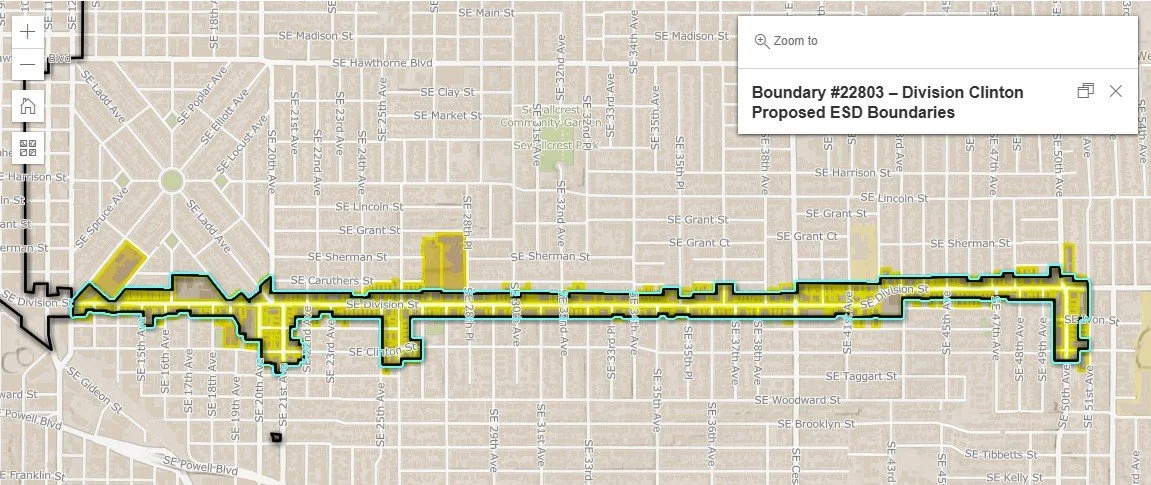
The proposed boundary captures the primary commercial parcels fronting SE Division Street, with targeted inclusions along SE Clinton Street where commercial activity is concentrated. The boundary was drawn to:
Include the majority of commercial and mixed-use properties that would directly benefit from ESD services
Follow the natural commercial corridor from the western gateway near SE 12th Avenue through the eastern boundary near SE 51st Avenue
Capture the density of restaurants, retail, and services that define the Division Clinton identity
Create a contiguous, manageable service area for cleaning, beautification, and programming
Proposed Rate structure
Coming soon!*
*Still being determined by an ESD Leadership Group
Who is assessed?*
*Still being determined by an ESD Leadership Group
Commercial Properties
Assessed
Large Commercial Properties
$TBD rate cap
Low Income and Market Rate Housing
$TBD
Condos & Non-Owner Occupied Townhouses
Assessed
Faith Centers
$TDB
who is not assessed?
Residential Single-Family Homes
No rate fee assessed
Nonprofit ownership
No rate fee assessed
Portland Public Schools
No rate fee assessed
Timeline
April - September 2026 Community Engagement
September 2026 submission to the City
September - November 2026 City Process
February 2026 City Council vote
Spring 2027 ESD begins
——————
Listening Sessions (Subscribe to our newsletter for invites)
Wednesday, July 17, 7pm - Virtual
Tuesday, July 23, 6:30pm - Imperial Bottle Shop
Tuesday, July 30, 7pm - Virtual
Wednesday, July 8, 7pm - People’s Food Co-op
Tuesday, September 1, 6:30pm - Rhinestone